
6 hr
Private Edge of the World Expedition: Sunrise or Sunset
- Private experience
- Personal attention
- Premium amenities
- Free cancellation
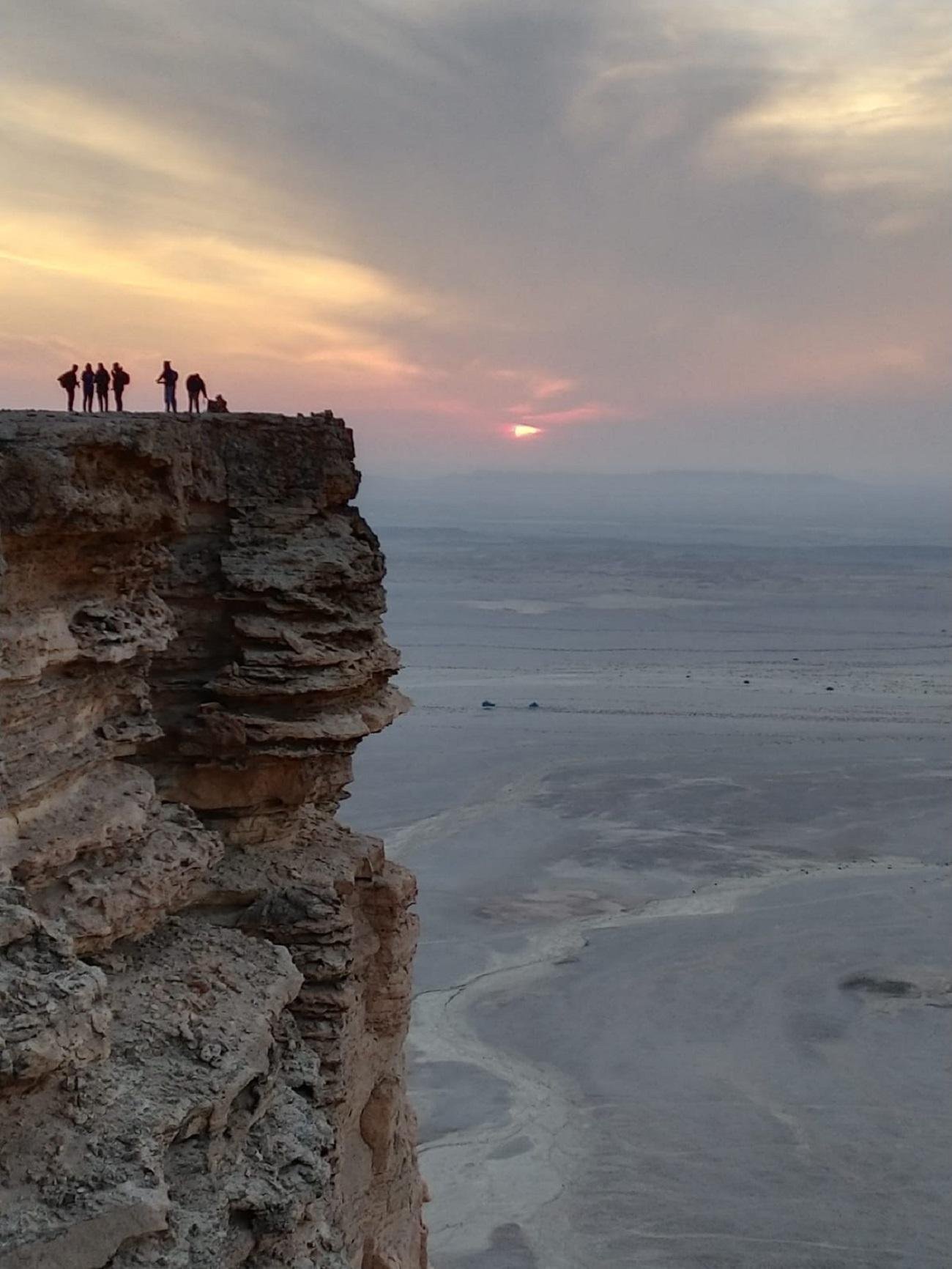
Edge Of The World Private Tour — Jebel Fihrayn, Reserved Transfers
Limestone falls away, the desert keeps going.
Compare fares, pick the fit — all bookings are mobile-voucher and eligible for free cancellation where shown.
6 hr
6 hr
4 hr
Hand-picked experiences loved by thousands of travelers
7 hours
Free Cancellation
Explore the majestic Tuwaiq mountains and Najd plateau on this private sunset hiking adventure from Riyadh.
6 hours
Free Cancellation
Experience the desert's majesty on a private sunset excursion to the Edge of the World, complete with dinner and stargazing.
3 hours
Free Cancellation
Experience the majestic Tuwaiq Mountains on this 3-hour guided desert adventure to the iconic Edge of the World.
Pick-up begins in the early afternoon so the vehicle reaches the escarpment before golden hour.
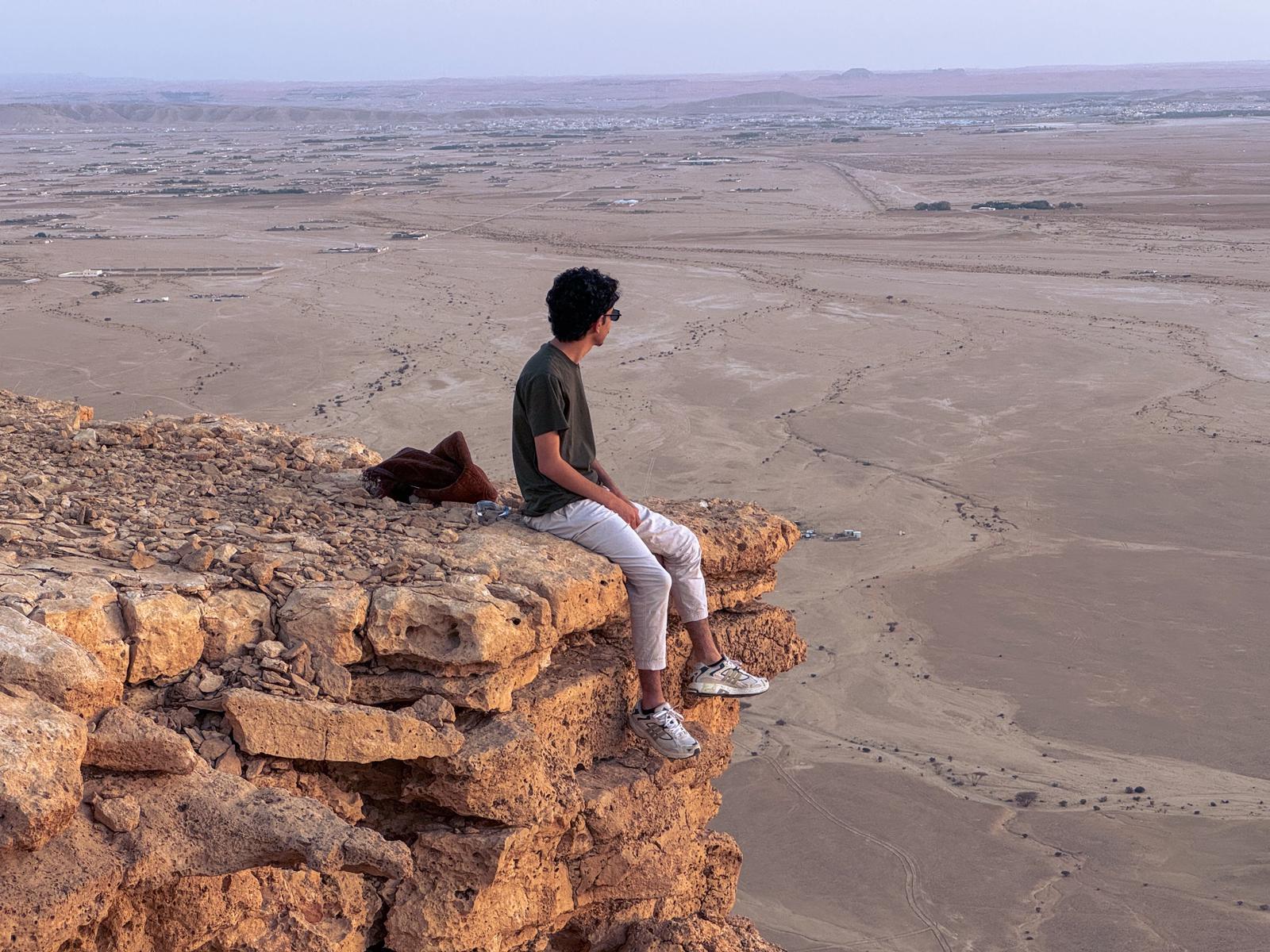
Guides orient guests to the safe viewing areas along the unfenced 300-metre cliff edge.
The core of any Edge of the World private tour, timed for the 15:30-18:00 light window with cooler temperatures.
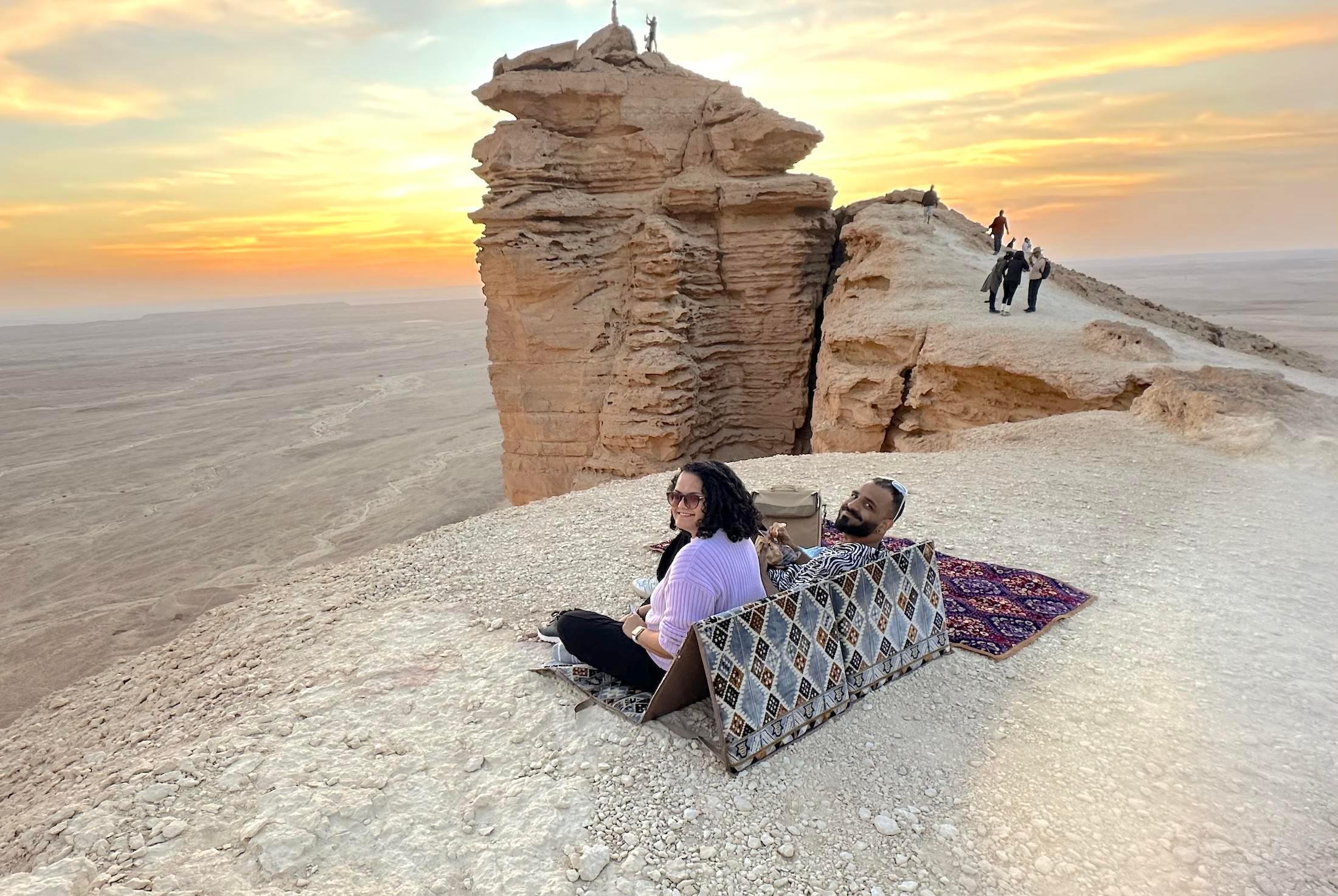
Many operators set up a portable table with tea and snacks facing the horizon.
Vehicles head back after dark, often with a stop for photos of the star-filled desert sky.
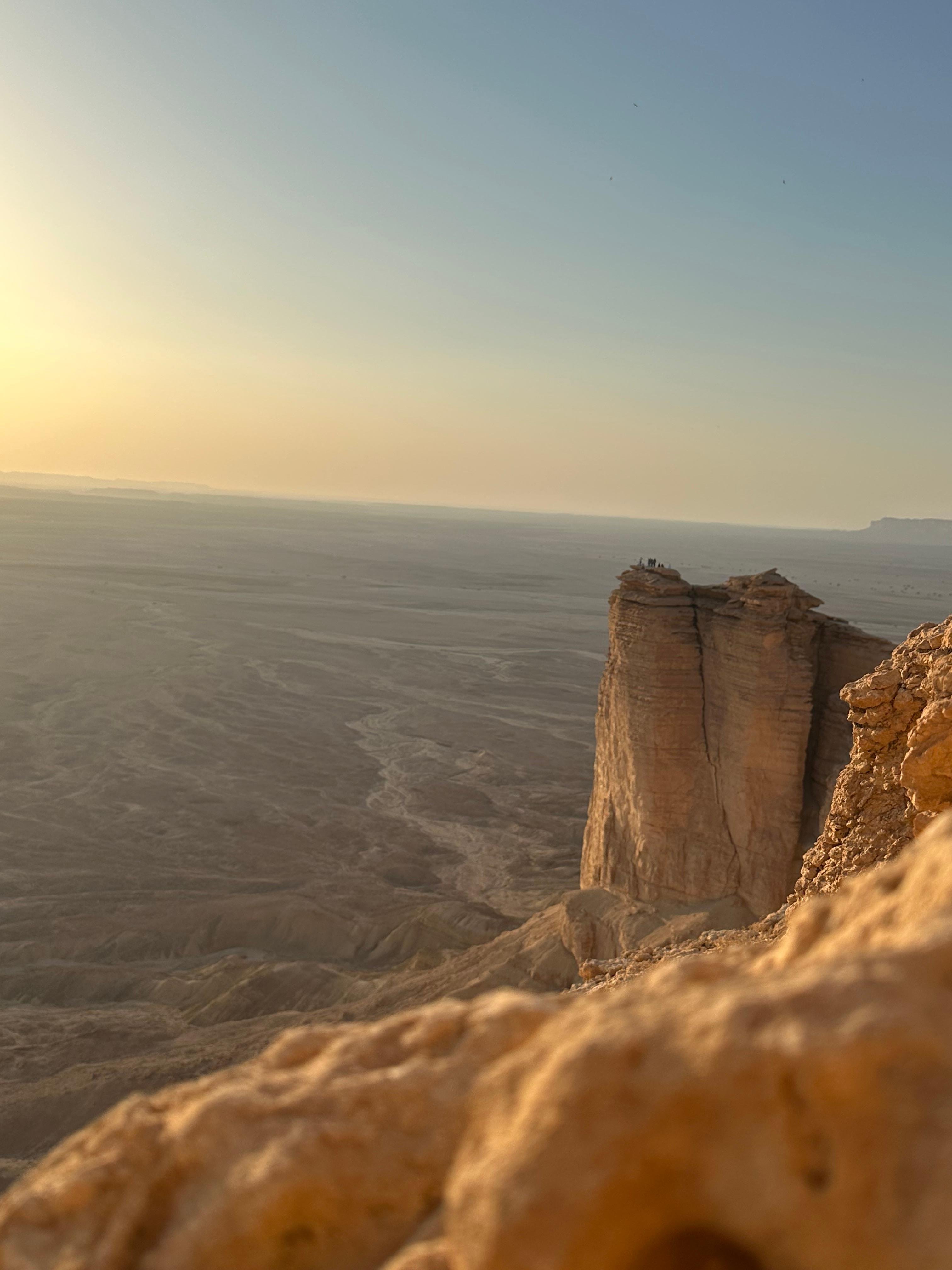
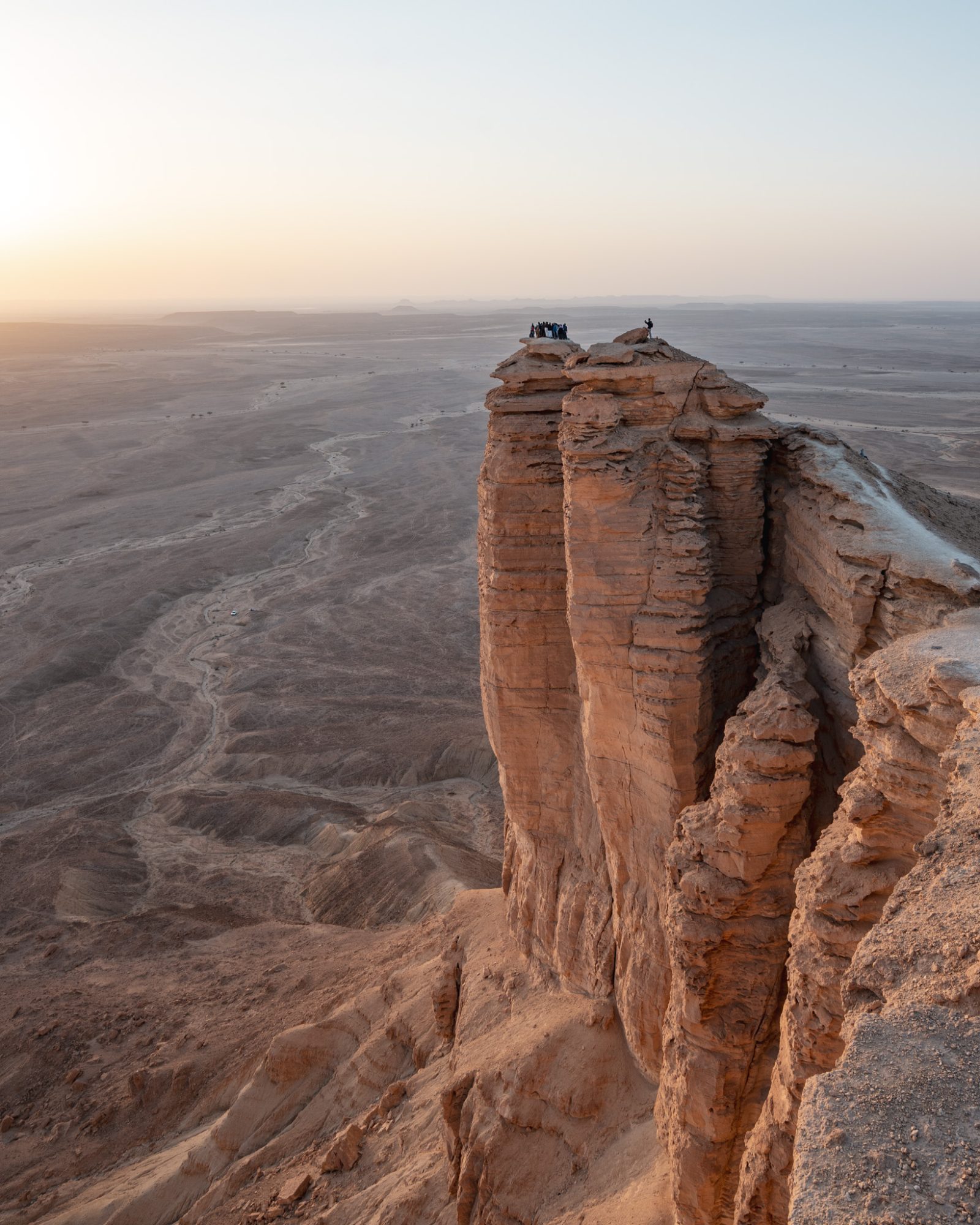
The primary viewing point along Jebel Fihrayn drops a sheer 300 metres into the desert plain below, with visibility extending over 100 kilometres on a clear day. It is the single most-photographed vantage point on the entire cliff line.
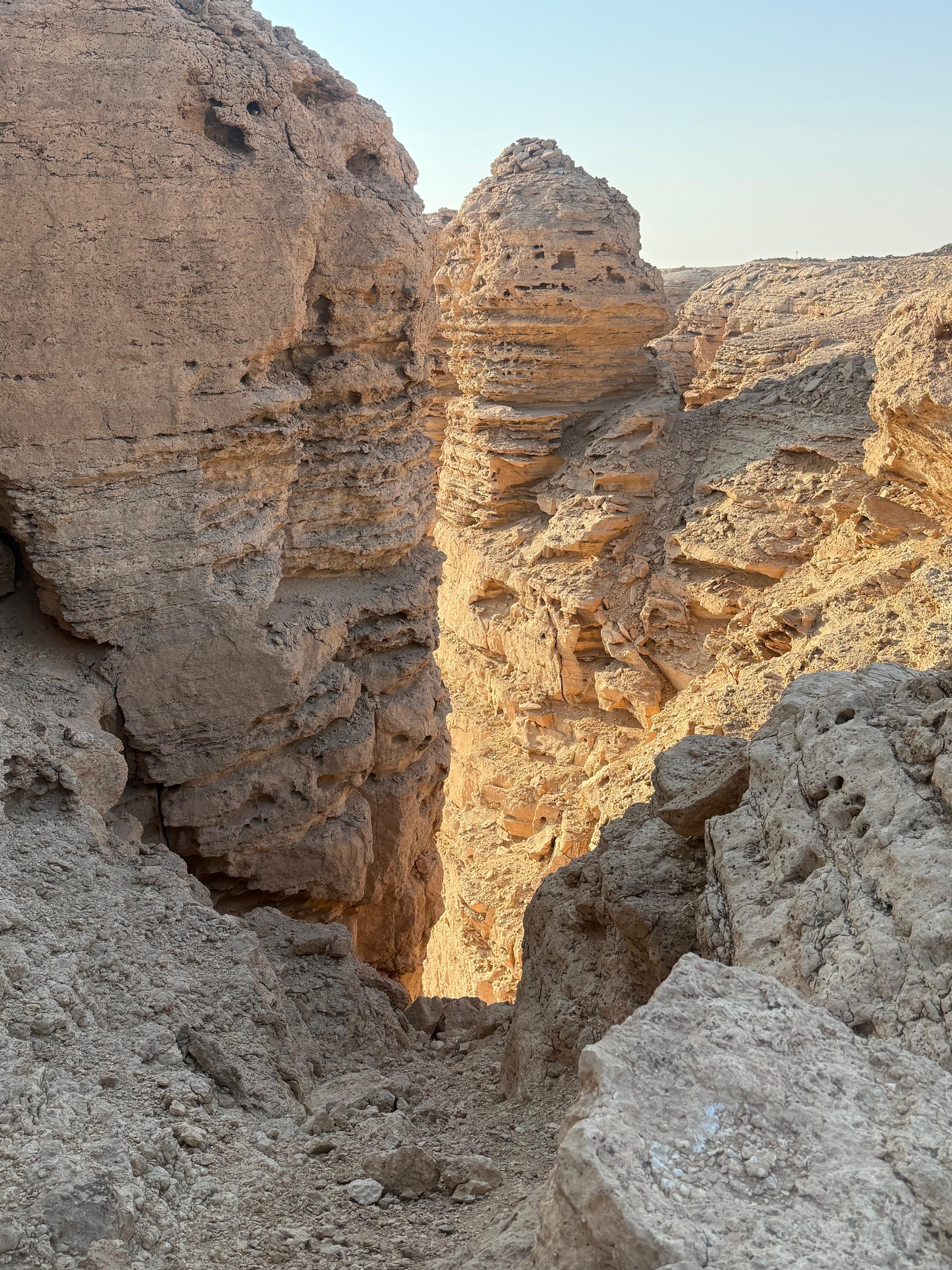
Sections of exposed limestone along the lower trails contain fossilized shells and coral, evidence that this plateau once sat beneath an ancient sea. Visitors can spot these marine fossils embedded directly in the rock surface underfoot.
This stretch of ridge along the Sadus Dam access road offers one of the two principal routes onto the escarpment and remains open every day of the week. The ridge provides sweeping views back toward the dam and surrounding wadi below.
A winding valley route scattered with acacia trees forms the more scenic, historically weekend-only approach to the cliff edge. The valley floor sits in sharp contrast to the barren plateau above, with vegetation clustering along dry stream channels.
Faint tracks crossing the plateau mark the remains of a historic trade route that once linked the Mediterranean with East Africa and India across the Arabian Peninsula. Traders moved along this corridor for centuries before modern roads existed.
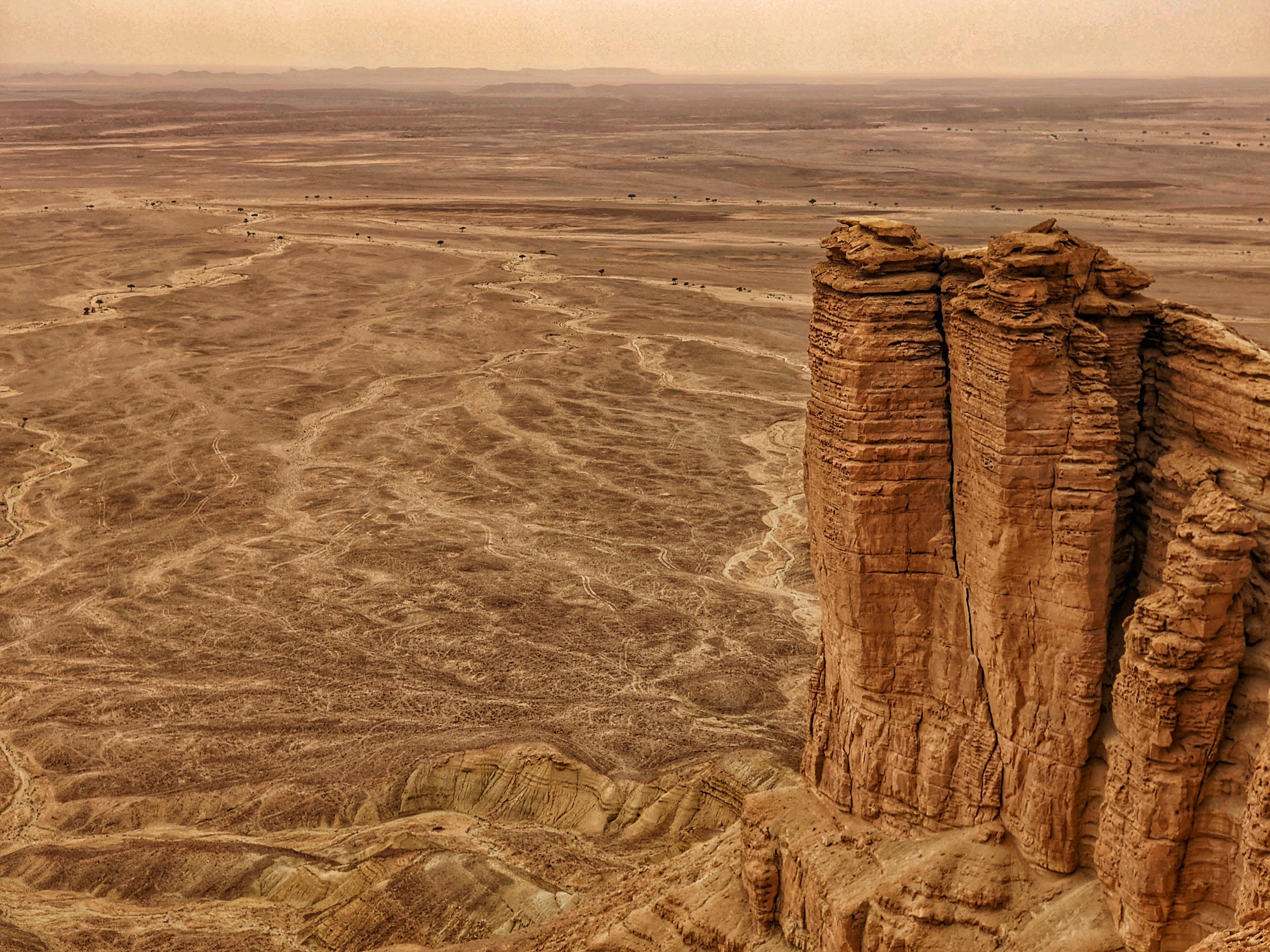
Winding dry riverbeds are visible from the clifftop, carved by seasonal flash floods that once cut through the limestone over millions of years. These channels are best seen from the main overlook in the low-angle light of late afternoon.
You leave Riyadh with the afternoon still bright, and for the first hour the road is ordinary highway. Then the asphalt thins. Your driver drops tyre pressure at a turnoff you would not have recognised, and the last stretch becomes graded track — washboard, dust, a slow crawl through a wadi bed where the surface turns soft. You arrive in the recommended window, 15:30–18:00, when the light is low and the heat has broken. You pay nothing at the site itself; entry is 0 SAR and there is no booth to pass. You walk from the vehicle across flat caprock, and the ground simply stops. Below you, several hundred metres down, the pale floor of the old seabed opens out. You edge toward a promontory, test the rock, and sit rather than stand. You find fossils if you look — shell impressions in the limestone at your feet, easy to miss until someone points at one. You watch the shadows lengthen across the wadis until the cliff face turns copper. Your guide keeps an eye on the undercut sections, steering you back from ledges that overhang more than they appear to. Afterwards you drink tea by the vehicle while the sky drains. The drive back is dark and quiet, the track picked out by headlights. Book an edge of the world private tour and this arc — highway, track, rim, return — is the shape of the day. Compare edge of the world private tour tickets by vehicle, group size, and whether refreshments are included.
All the details about your upcoming adventure in one place
An edge of the world private tour takes you northwest of Riyadh to Jebel Fihrayn, where the Tuwaiq Escarpment drops away in a sheer limestone cliff above the old caravan plain. A dedicated driver-guide handles the 4x4 track through the desert, and camel trails, fossil beds, and Najd wadi scenery fill the approach. Most Riyadh landmarks tours stay in the city, so edge of the world private tour tickets suit travelers who want the escarpment viewpoint on their own schedule.
The cliff that travellers call the Edge of the World is the eroded rim of a seabed. The Tuwaiq Escarpment is Jurassic limestone, laid down when this part of Arabia lay beneath shallow warm water, and the fossils pressed into its ledges are marine. Jebel Fihrayn is the most photographed section of that 800-kilometre arc, rising roughly 300 metres above the plain at Jebel Fihrayn, Tuwaiq Escarpment, approximately 90-120 km northwest of Riyadh, Saudi Arabia. What gives the place its name is not height but absence. The escarpment ends abruptly, and beyond it the ground drops to a pale floor that runs uninterrupted to the horizon. Caravan routes once threaded that floor, linking the oases of Najd to the trading towns of the west, and the wadis below still trace their old paths. An edge of the world private tour exists partly because the approach is harder than the destination: the final kilometres are unpaved track, corrugated and soft in places, and the turnoffs are unmarked. The site carries no gate, no ticket booth, and no entrance fee — 0 SAR. This is unusual for a landmark of its stature, and it shapes everything about how the escarpment is used. There is no queue system, no closing bell, no custodial staff to reset the ground each evening. Access runs 00:00–23:59, every day of the week. Responsibility for the place therefore sits with the people who drive out to it, which is the argument most often made for guided travel here rather than a rented sedan and a mapping app. Geologically, the formation is a cuesta: a gently dipping layer of resistant rock whose downdip edge has been undercut and shed. Freeze-thaw is negligible in this climate; the sculpting agent is wind-driven sand and the occasional violent rainfall that scours the softer marl beneath the caprock. The result is a serrated line of promontories, some of them narrow enough to stand on with open air on three sides. Vegetation is sparse — acacia, desert grasses, the odd hardy shrub in a wadi bed where runoff collects. Riyadh's growth has changed the escarpment's meaning. What was once a herders' landmark is now a weekend destination for a metropolitan population of more than seven million, and the Saudi Tourism Authority lists it among the Riyadh landmarks it actively promotes. Formal conservation planning has followed, with discussion of managed access continuing through 2026. Anyone comparing edge of the world private tour tours will find the operators clustered around the same access corridor, and any well-run edge of the world private tour tour will treat that fragility as part of the brief rather than an afterthought. The official reference for the site remains https://www.visitsaudi.com.
The escarpment simply ends, and the ground beyond it runs uninterrupted to the horizon.
Loose, breathable, modest clothing is recommended, covering shoulders and knees, since the escarpment offers no shade and daytime temperatures can exceed 40°C in summer. Closed-toe shoes with good grip are essential for the loose gravel and uneven limestone at the cliff edge. A light windproof layer helps once the sun drops and the plateau turns breezy in the evening.</br>
There is no official gate, ticket booth, or bag check at Jebel Fihrayn, so visitors carry their own gear across the open desert plateau. A daypack with a hydration system is far more practical than a handbag given the unpaved, rocky approach. Vehicles are typically parked informally near the ridge, so valuables should stay out of sight inside the car.
Photography and drone use are generally permitted at the escarpment, though drone flights near Riyadh can require prior approval under Saudi civil aviation rules, so check current regulations before flying. Tripods are fine on the open rock but should be kept back from the unguarded 300-metre drop. Flash and artificial lighting add little value given the natural golden-hour light most visitors come for.
Children must be supervised closely at all times, as the cliff edge is unfenced with a sheer 300-metre drop. Families choosing an Edge of the World private tour should keep young children on a leash-style harness or hold hands near the rim.
The site has no paved paths, ramps, railings, or restrooms, and the final approach is rough, potholed dirt track unsuitable for standard sedans. Wheelchair users and those with limited mobility will find the loose gravel and unmarked cliff edge very difficult to navigate safely.
There are no cafes, kiosks, or vendors at Jebel Fihrayn, so all food and water must be brought in. Many Edge of the World private tour operators include a packed lunch or sunset tea service as part of the itinerary, set up on portable tables away from the cliff edge.
No barrier, open access
Quiet on weekday mornings
Evening crowds build before weekend
Busiest day of the week
Popular for group tours
Best hours
15:30–18:00 golden-hour arrival, site open 24 hours daily
Address
Jebel Fihrayn, Tuwaiq Escarpment, approximately 90-120 km northwest of Riyadh, Saudi Arabia
Terrain
Unpaved, rocky, uneven cliff edge — not wheelchair accessible
Fee
Free entry, no official gate or ticket booth
Vehicle
4x4 or high-clearance SUV recommended for desert tracks
Official info
https://www.visitsaudi.com
Car · 1.5-2 hours from central Riyadh · Fuel cost only, no toll
Self-drive via the Riyadh-Qassim Highway then unpaved desert tracks toward Sadus or Acacia Valley; a 4x4 or high-clearance SUV is strongly advised for the rutted final stretch.
Taxi · 1.5-2 hours from central Riyadh · Fare varies by distance
Ride-hailing apps can reach the general area but many drivers are unfamiliar with the unmarked desert tracks near the escarpment.
Private tour vehicle · 1.5-2 hours each way · Included in tour package
Most visitors join an Edge of the World private tour with a 4x4 and driver who knows the Sadus Dam route, avoiding navigation issues on unmarked roads.
Most Edge of the World private tour bookings can be cancelled free of charge up to 24-48 hours before departure, since the site itself carries no entrance or conservation fee (0 SAR). Operators typically charge a partial fee for cancellations made within that window because vehicles and guides are reserved in advance.
Recommended time
Half a day
Budget around 5 to 6 hours door to door for an edge of the world private tour: roughly 90 minutes each way on desert roads, with 2 to 2.5 hours at the escarpment itself for hiking, photos, and coffee at the cliff edge. Add 30 to 60 minutes if you're timing the drive to land inside the 15:30-18:00 golden-hour window, since the last stretch of track slows down and eats into your buffer. There's no gate or ticket queue since entry is free and unofficial, so the only real bottleneck is parking space near the main viewpoints once several groups arrive at once. Trim the on-site time to under an hour only if you're purely stopping for sunset photos rather than walking the rim.
Crowd levels through the day
Weather · crowds · average price — dots go green to amber to red as each metric rises.
Daytime temperatures drop to a comfortable 15-25°C, making this the most popular season for an Edge of the World private tour, with cooler winds along the cliff edge and clearer long-distance visibility.
Mild temperatures and occasional desert bloom make spring a strong shoulder season, though weekend crowds pick up as the weather turns pleasant again after winter.
Midday heat regularly exceeds 40°C, so visits are best restricted to the late-afternoon golden-hour window; daytime foot traffic drops sharply during these months.
Temperatures begin easing from summer highs, and cooler evenings return, drawing visitors back for sunset trips before the winter peak season begins.
The Acacia Valley route has historically been restricted to Fridays and Saturdays, while the Sadus Dam road stays open daily, so confirm which route your Edge of the World private tour will use.
There are no shops or refill stations at the site, so pack extra water beyond what feels necessary, especially for a summer Edge of the World private tour.
The cliff edge is unfenced and drops roughly 300 metres, and loose gravel near the lip can shift underfoot, so stay well back from the edge.
Low-riding sedans struggle on the potholed dirt tracks leading to the escarpment; a 4x4 or SUV avoids the risk of a flat tire.
The rock along some hiking trails contains visible marine fossils from when this area was an ancient seabed, adding an extra stop for curious visitors.
Temperatures swing sharply between the hot open desert and the windy plateau edge, so a light jacket makes the evening portion of any trip more comfortable.
Since the Edge of the World itself has no ticket booth or official fee, ask tour operators exactly what their private tour package covers before booking.
Near Sadus village, Tuwaiq Escarpment
Open at all times, used by most private tour vehicles
Get directionsWestern approach to Jebel Fihrayn
Historically restricted to Fridays and Saturdays; confirm current access with operator
Get directionsCentral Riyadh, exact location set by operator
Standard start point for most Edge of the World private tour packages
Get directionsThe escarpment now marketed as an edge of the world private tour begins as sediment. Roughly 150 million years ago, in the Jurassic, shallow warm seas covered central Arabia. Carbonate mud accumulated across that seabed. It hardened into the limestone of the Tuwaiq formation, named for the crescent-shaped ridge that curves some 800 kilometres through the Najd plateau. The rock at Jebel Fihrayn is therefore older than the desert around it. Uplift came later. From roughly 30 million years ago, during the Oligocene and into the Eocene-Miocene transition, the opening of the Red Sea Rift tilted the entire Arabian Shield eastward. The western margin rose; the sedimentary cover cracked and drained. Wind and infrequent rain then stripped the softer strata, leaving the harder limestone standing as a cliff wall roughly 300 metres above the plain. Fossils confirm the marine origin plainly. Coral colonies, bivalve clams and ammonite spirals sit exposed in the rock face and scattered across the scree, evidence that the surrounding desert once lay beneath water. Geologists have mapped the Tuwaiq Mountain Limestone since the Aramco surveys of the 1940s, when American and Saudi field teams first charted the Najd stratigraphy in detail. Human history follows the base of the cliff rather than its summit. The dry valley below carried a caravan corridor linking the incense kingdoms of Yemen to the Levant and onward to Persia, with camel trains using the wadi floor as a natural roadbed. Watering points and rock shelters along that route sustained traffic for centuries. Bedouin herders of the Najd knew the ridge as Fihrayn long before any foreign map recorded it, and the name persists. Modern visitors arrive by four-wheel drive over unmarked track, which is why an edge of the world private tour became the standard means of access. There is no gate and no ticket booth; entrance costs 0 SAR. Guided edge of the world private tour tours, single-vehicle edge of the world private tour tour formats, and packaged edge of the world private tour tickets all cover transport rather than admission. Jebel Fihrayn tours remain among the defining Riyadh landmarks.
Shallow warm seas deposit the carbonate mud that hardens into Tuwaiq limestone.
Opening of the Red Sea Rift tilts the Arabian Shield eastward and uplifts the western margin.
Erosion strips softer strata, exposing the escarpment wall above the plain.
Caravan routes carrying incense from Yemen to the Levant and Persia follow the wadi floor below the cliff.
Aramco field surveys formally map and name the Tuwaiq Mountain Limestone formation.
Saudi Arabia opens tourist visas, bringing international traffic to Jebel Fihrayn.
The site remains free to enter, with no gate or ticket booth, reached only by unmarked desert track.
Stand at the top of the 300-meter cliff face where the Tuwaiq Escarpment falls away in a sheer 1,000-foot drop, giving an uninterrupted horizon line that blends sky and desert floor. Guides on an edge of the world private tour often set up here first since the wide plateau allows several angles without crowding. Shoot wide to capture the dried riverbeds threading across the plain far below.
A narrow natural passage cut into the rock that locals call the window, framing a tunnel-like view down to the lower plateau. Position a subject inside the gap so the opening frames the desert beyond, an effective natural border for portrait shots. Footing is uneven gravel here, so keep a firm stance near the opening.
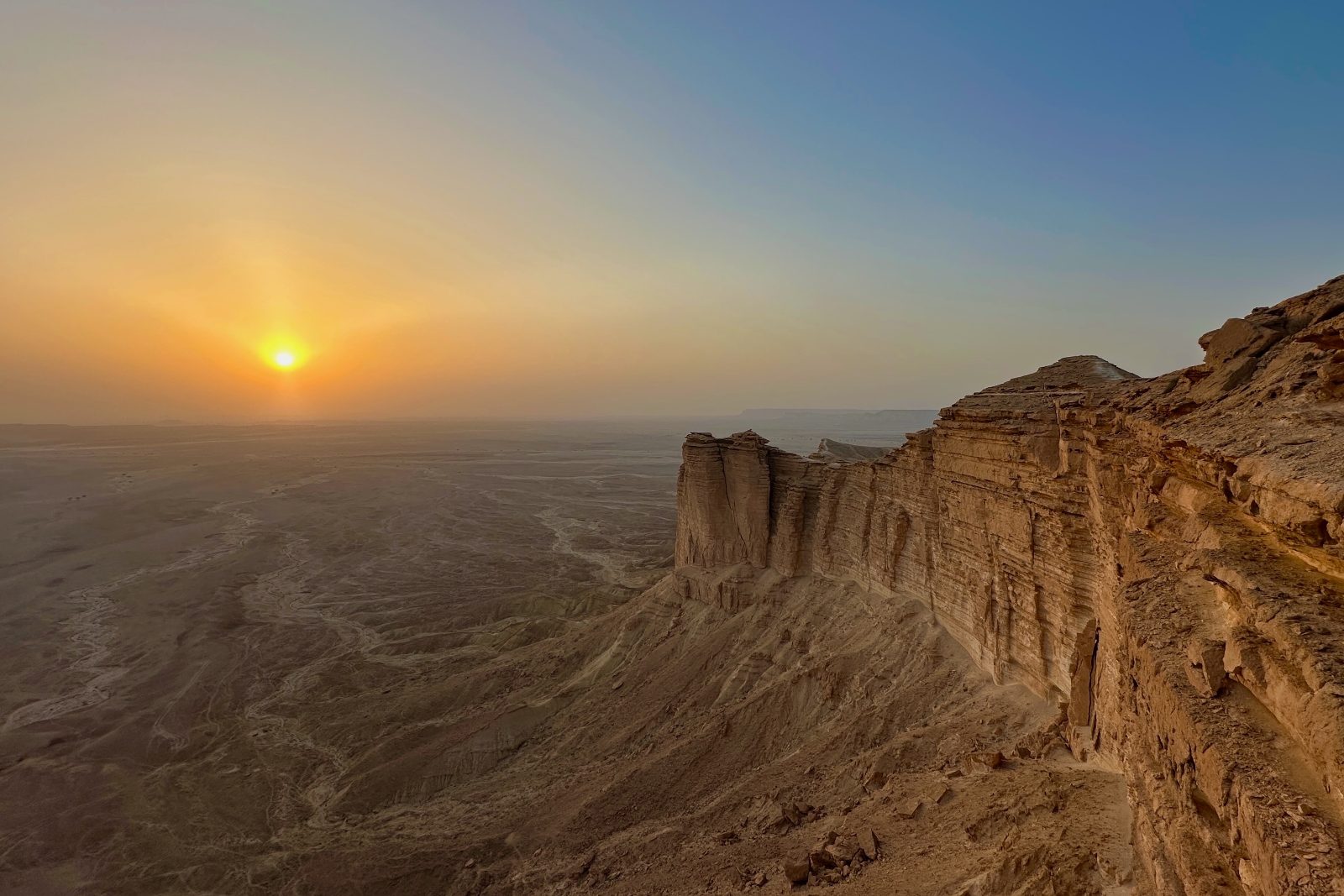
Flat rock ledges jutting from the escarpment are the spot photographers favor for silhouette shots against the setting sun. Stand back from the lip and use a low angle so the subject's outline stands sharp against the glowing sky. These ledges also work well for a skip-the-line edge of the world experience since they sit close to the main parking approach.
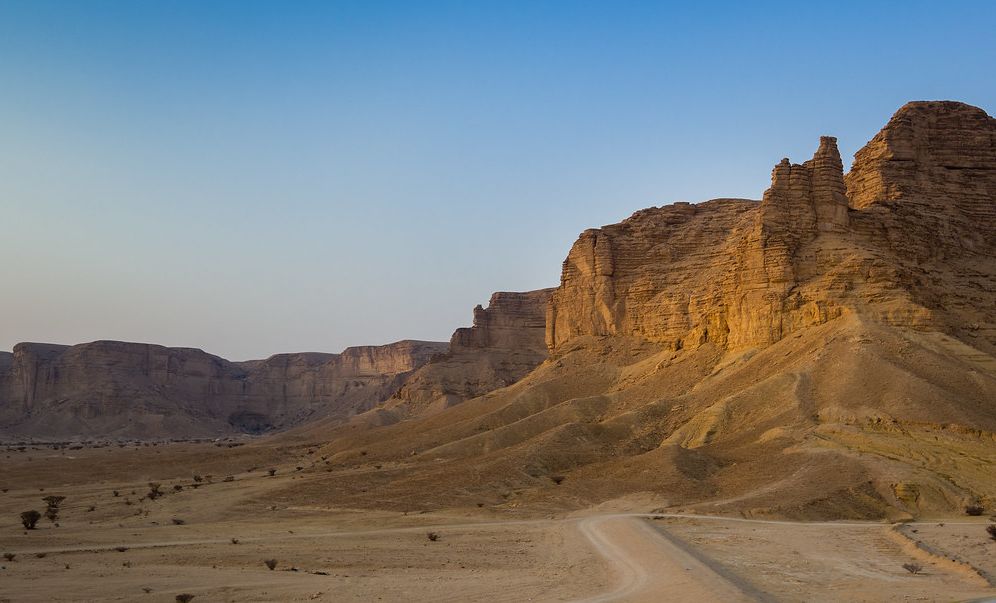
A two-summit rock formation visible from the main ridge, useful as a distinctive background element that anchors a photo to this specific escarpment rather than a generic desert. Frame it from the western viewpoints where both peaks separate clearly on the skyline.
A viewpoint overlooking the old caravan path still faintly visible as a line worn into the plain, where camels and herders can sometimes be seen crossing below. This spot rewards a telephoto shot down onto the flats rather than a wide horizon frame.
An edge of the world private tour is less a stroll than a supervised expedition: unfenced 300-meter drops, loose gravel, and a bumpy off-road approach mean the day is shaped entirely around keeping small hands held and feet steady. Families who plan around the terrain rather than fight it tend to have the smoother trip.
Leave them in the vehicle. The final stretch is soft sand and rock, and the clifftop plateau has no paved or level surface for wheels of any kind.
Children old enough to reliably follow instructions and stay an arm's length from edges do best, generally school-age and up. A private driver experienced on this off-road terrain matters more for younger kids, since the 4x4 track itself has no guardrails.
There is no gate, ticket booth, or restroom on site, so plan bathroom stops and diaper changes before leaving Riyadh. Pack a full baby-change kit if traveling with an infant.
Keep the visit short and slow, since uneven rocky ground tires young legs fast and the exposed plateau offers no shade to rest in. Build in frequent water breaks rather than one long walk to the far viewpoints.
Bring more water than you think you need, plus hats, sunscreen, and a pop-up shade or umbrella, since there is no shelter anywhere on the escarpment. This matters even during the recommended 15:30 to 18:00 arrival window, when daytime heat lingers.
Book edge of the world private tour tours with a driver experienced in desert 4x4 driving rather than a standard rental car, since the access road includes loose gravel and soft sand unsuitable for children waiting in an unstable vehicle.
Real experiences from real travelers
The last forty minutes off the highway are genuinely rocky and our driver aired down the tyres before we started, which tells you what kind of track it is. We reached the escarpment about an hour before sunset and the flat desert floor below turned copper as the light dropped. Bring more water than you think you need in July
What struck me most was the quiet — no wind at all when we arrived, just the sound of gravel underfoot along the Tuwaiq cliff. Our guide pointed out marine fossils embedded in the limestone right where we were standing, which I would have walked straight past. The edge of the world private tour meant we could linger at the promontory long after the group buses had turned back
I had seen pictures of Jebel Fihrayn and assumed they were heavily edited, but the drop really is that abrupt and the horizon really does look like an ocean that dried up. We were the only vehicle at our lookout point for about twenty minutes. Sturdy shoes matter more than anything else here
Our driver knew the escarpment well and took us to a quieter ledge away from the main crowd, which made the whole thing feel private rather than processed. The drive out from Riyadh is long and the road surface deteriorates badly toward the end, so anyone with back problems should think carefully. Still glad we did the Riyadh escarpment tour rather than skipping it
Standing on the limestone shelf you can trace the horizontal bands in the cliff face for what feels like miles in either direction. Our guide explained how the plateau was once seabed while we watched the shadows lengthen across the wadi below. Booking edge of the world private tour tickets in advance meant we had a fixed pickup and no waiting around
We went in the morning in January and it was genuinely cold at the top with a hard wind coming across the plateau, so a jacket was necessary. Visibility was excellent and we could see the caravan route lines snaking across the desert floor far below. The 4x4 handled the boulder sections without drama
Summer heat is no joke out there, so we did a late afternoon departure and reached the finger-shaped headland around six. The rock still radiated warmth through the soles of my shoes an hour after sunset. Our small-group edge of the world private tour tours option meant six of us total, which felt right for a place this exposed
This is not a manicured attraction — there are no railings and no barriers, just an escarpment and a very long drop. Our driver was firm about how close he would let us go, which I appreciated. I would not attempt the access track in an ordinary car
Our guide picked up a shell fossil from the ground and handed it to me, then explained it had been sitting on that plateau since the whole area was underwater. The scale of the Najd landmarks out here does not translate to a phone screen at all. Book an edge of the world private tour tour if you want to control your own timing
We went in June and the heat off the limestone in the middle of the day was intense enough that we cut our time at the rim shorter than planned. The escarpment itself is spectacular and the drive out gives you a real sense of how empty the Najd plateau is. An edge of the world private tour is the only sensible way to reach it without your own off-road vehicle
Everything you need to know for your journey
The Edge of the World site itself has no fixed operating hours and is accessible 00:00-23:59 every day of the week, though most edge of the world private tour departures are timed for the 15:30-18:00 golden-hour window.
No, entrance to Jebel Fihrayn is free (0 SAR) with no official gate or ticket booth; any cost quoted for an edge of the world private tour covers transport, guiding, and vehicle use rather than a site fee.
The terrain is unpaved, rocky, and uneven with no ramps or railings, so the site is not wheelchair accessible and mobility-impaired visitors should discuss alternatives with their tour operator.
There is no formal bag check since the site has no gate, but visitors on an edge of the world private tour typically carry a daypack with water, sun protection, and a camera.
Glass bottles, open flames outside fire pits, fireworks, loud speakers, and off-road driving beyond marked tracks are among the items and activities discouraged at the escarpment.
Yes, photography is welcome and encouraged, since the golden-hour light over the Tuwaiq Escarpment is one of the main draws of an edge of the world private tour, though drone use may require separate approval.
Winter and spring offer the mildest temperatures for an edge of the world private tour, while summer visits are best restricted to the late-afternoon 15:30-18:00 arrival window to avoid peak heat.
Loose, breathable clothing that covers shoulders and knees is recommended, along with closed-toe shoes for the loose gravel near the cliff edge.
Yes, but there are no vendors on-site, so food and water must be packed in; many edge of the world private tour packages include a light snack or tea service.
Self-driving requires a high-clearance vehicle and roughly 1.5-2 hours from Riyadh via the Riyadh-Qassim Highway, followed by unpaved desert tracks toward Sadus or Acacia Valley.
Yes, but children must be closely supervised near the unfenced 300-metre cliff edge throughout any edge of the world private tour.
Most edge of the world private tour tickets can be cancelled free of charge 24-48 hours in advance, since the destination itself has no entrance fee to refund.
Yes, many visitors pair the Edge of the World with a stop at the historic Diriyah district or downtown Riyadh landmarks tours on the same day trip.
A historic dam near Sadus village along one of the two main access roads to the escarpment. It offers a quieter, always-open alternative route compared to the Acacia Valley path.
A scenic valley approach to Jebel Fihrayn historically open only on Fridays and Saturdays. Its winding track passes acacia trees scattered across the desert floor.
Faint traces of a historic trade route once linking the Mediterranean with East Africa and India cross the plateau near the cliff edge.
Marine fossils including shells and coral are visible in the limestone, remnants of the ancient ocean bed that once covered this plateau.
Most visitors base themselves in central Riyadh, where the widest range of hotels and Edge of the World private tour operators are located.
A smaller selection of boutique lodging near the historic Diriyah district, convenient for combining a desert trip with cultural sightseeing.
Some tour companies offer overnight desert camping near the escarpment rather than fixed lodging, with tents and basic gear supplied.
Join thousands of happy travelers who have discovered this incredible experience
Book Your Experience Now