
6 hr 30 min
Riyadh 4x4 Edge of the World Sunset Safari
- Expert local guide
- Small group
- Skip-the-line access
- Free cancellation
Edge Of The World Overnight Tour — Escarpment Camps & Night Skies
A cliff that ends the desert, a sky that begins it.
Compare fares, pick the fit — all bookings are mobile-voucher and eligible for free cancellation where shown.
6 hr 30 min
7 hr
6 hr
Hand-picked experiences loved by thousands of travelers
6 - 7 hours
Free Cancellation
Escape the city for a guided trek through the Tuwaiq Mountains to witness breathtaking desert sunset vistas.
6 hours
Free Cancellation
Experience the majestic Jebel Fihrayn on a personalized 4x4 private tour from Riyadh featuring exclusive photo stops and local snacks.
4 hours
Free Cancellation
Experience the Tuwaiq Mountains on this private tour to the historic Darb Al-Manjoor trail and breathtaking desert cliffs.
Pick-up from central Riyadh and drive northwest via Sadus or Acacia Valley routes toward the escarpment
Switch to off-road vehicle for the final rough gravel and sand track to the cliff top
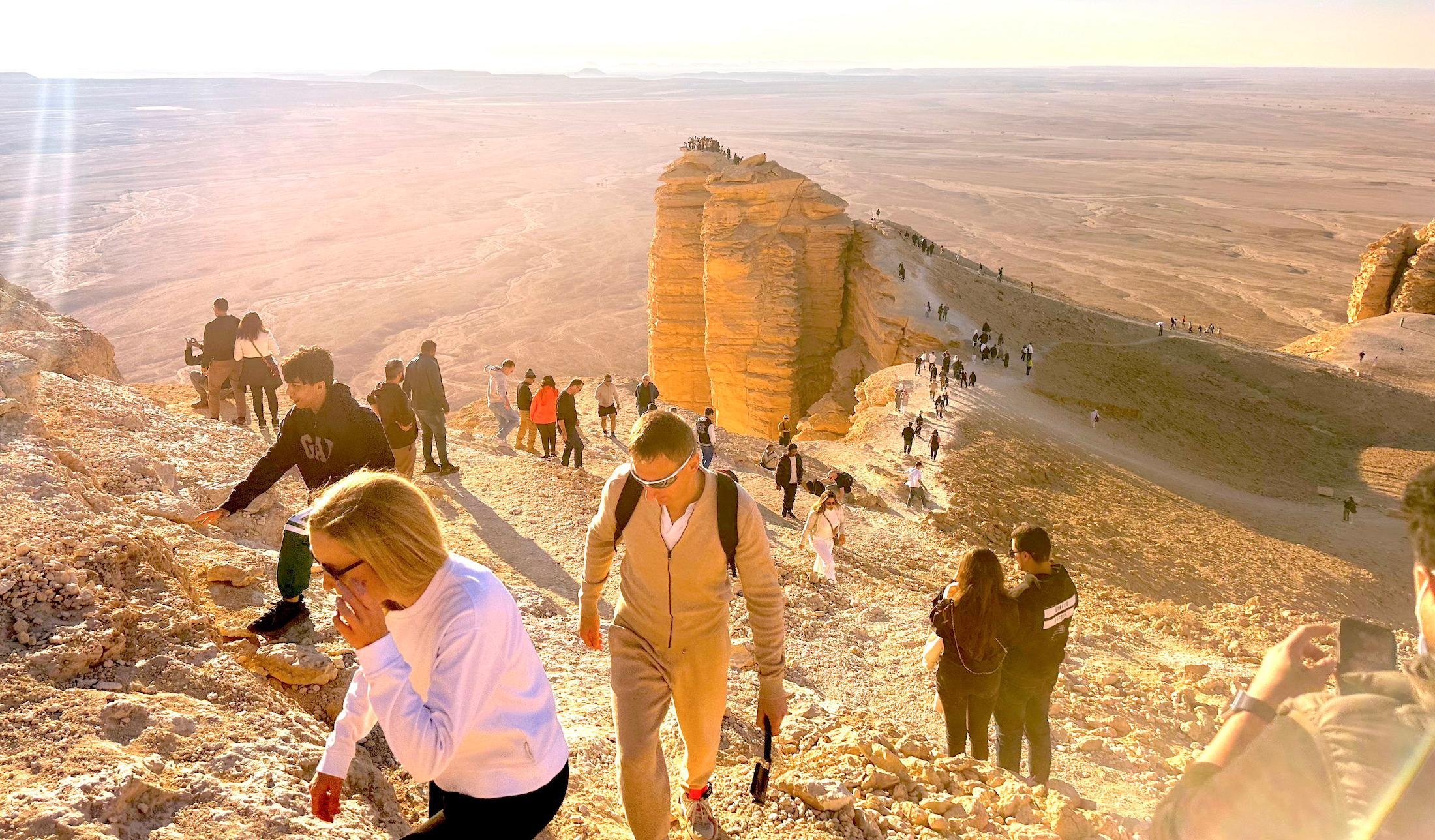
Walk along the plateau edge, view the sheer drop and horizon, explore nearby rock formations
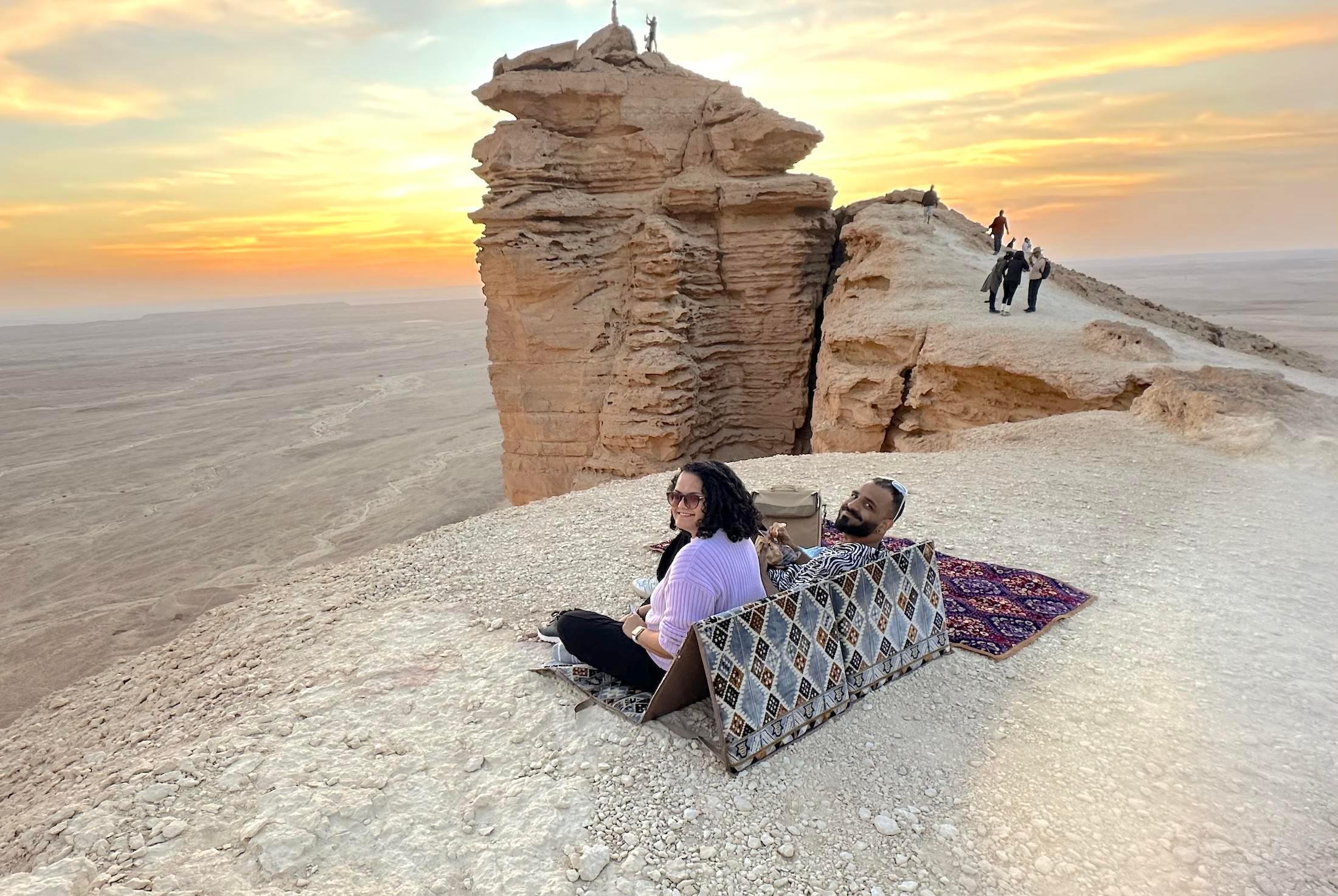
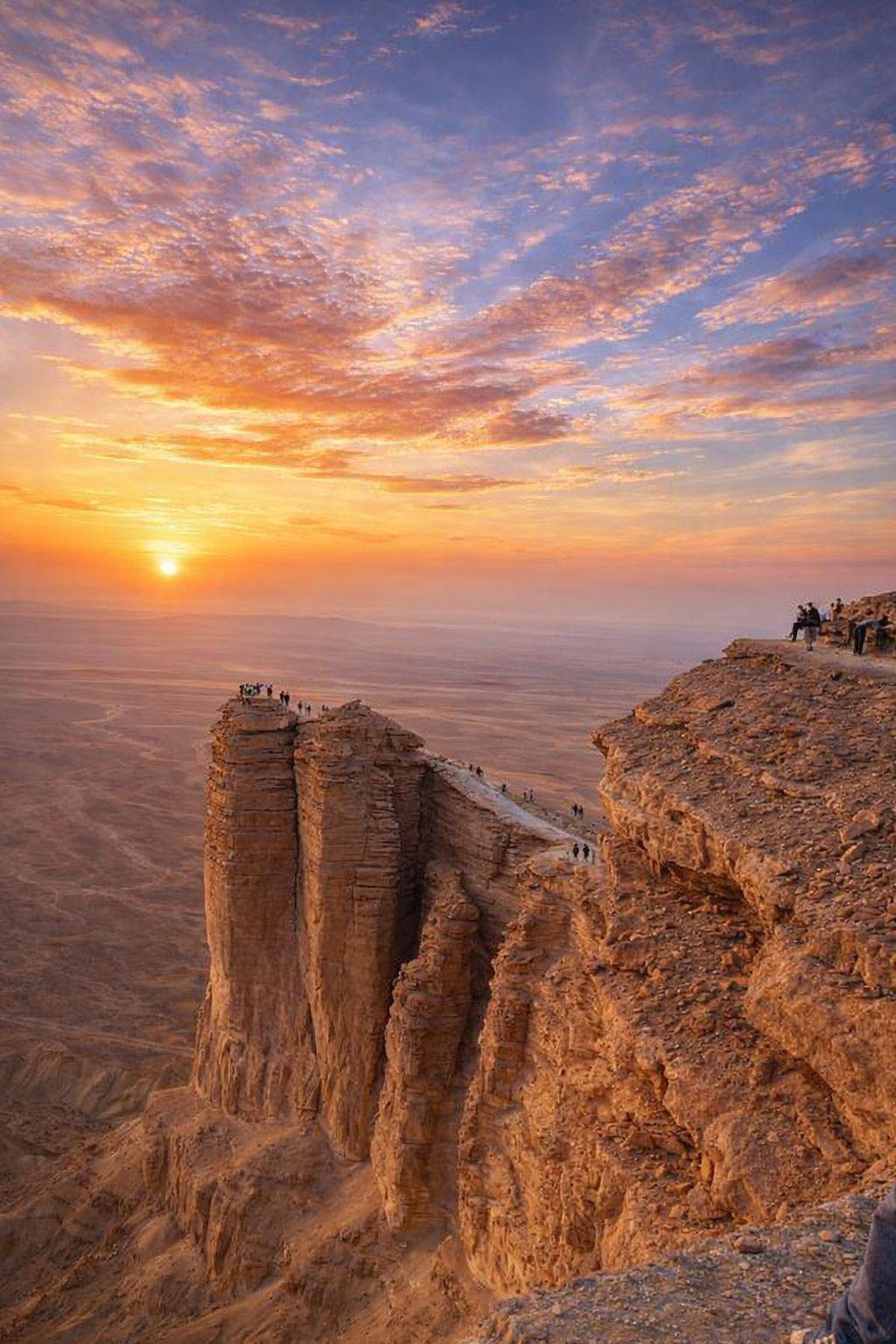
Watch the escarpment turn gold and red as the sun sets over the plain below
Evening meal at a camp setup followed by stargazing away from city light pollution
Sleep in tents near the cliff, then drive back to Riyadh after sunrise
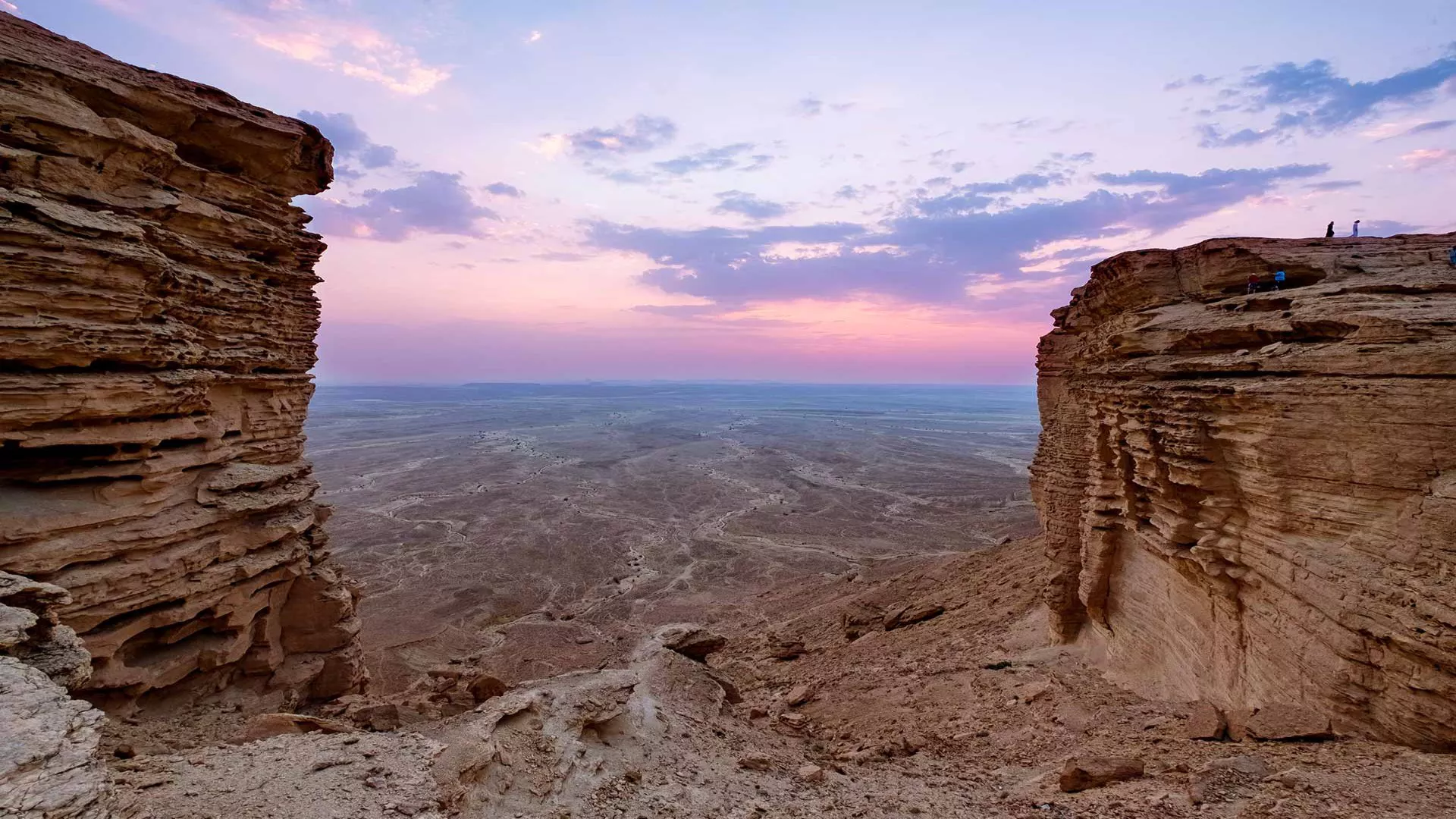
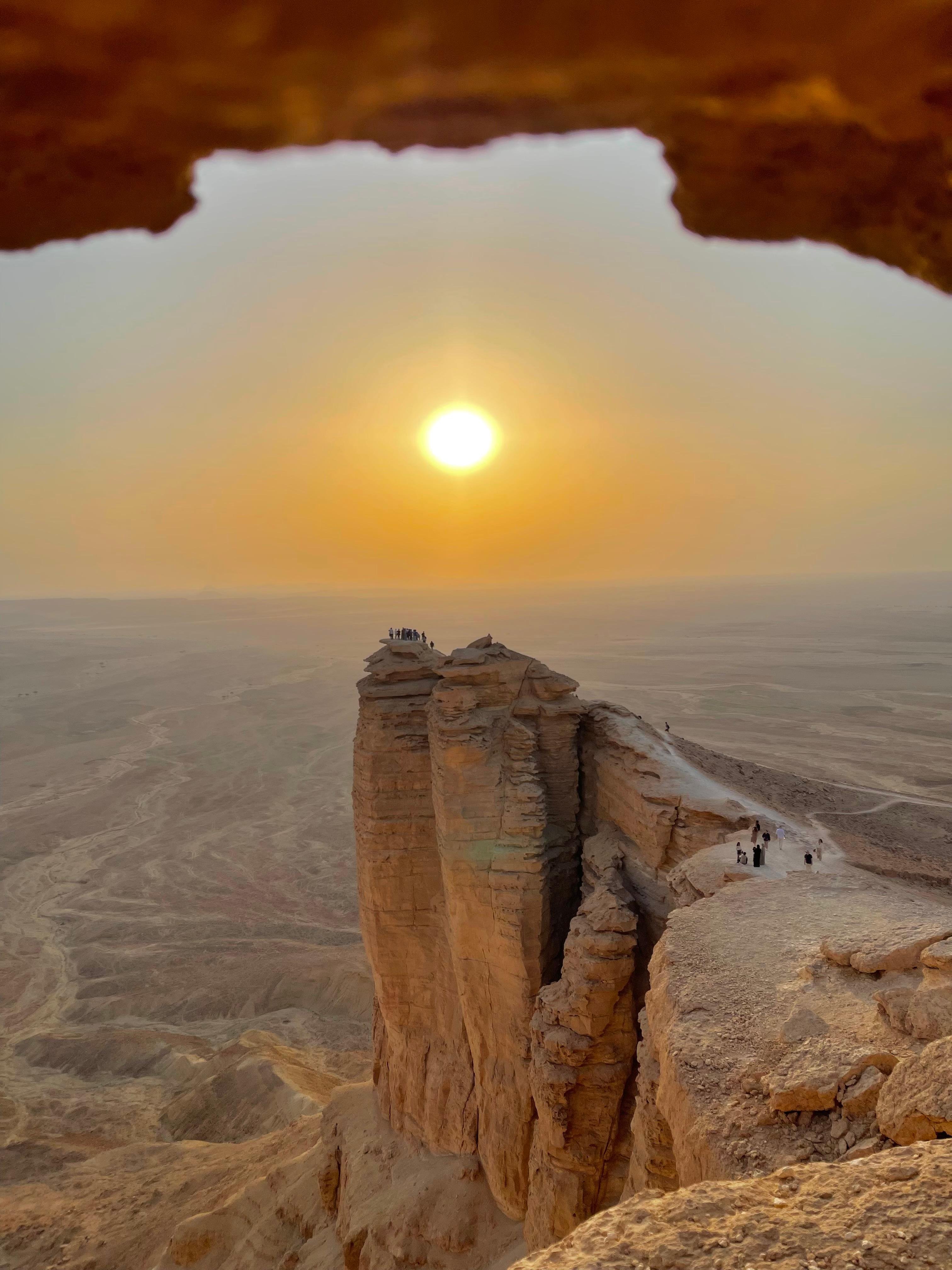
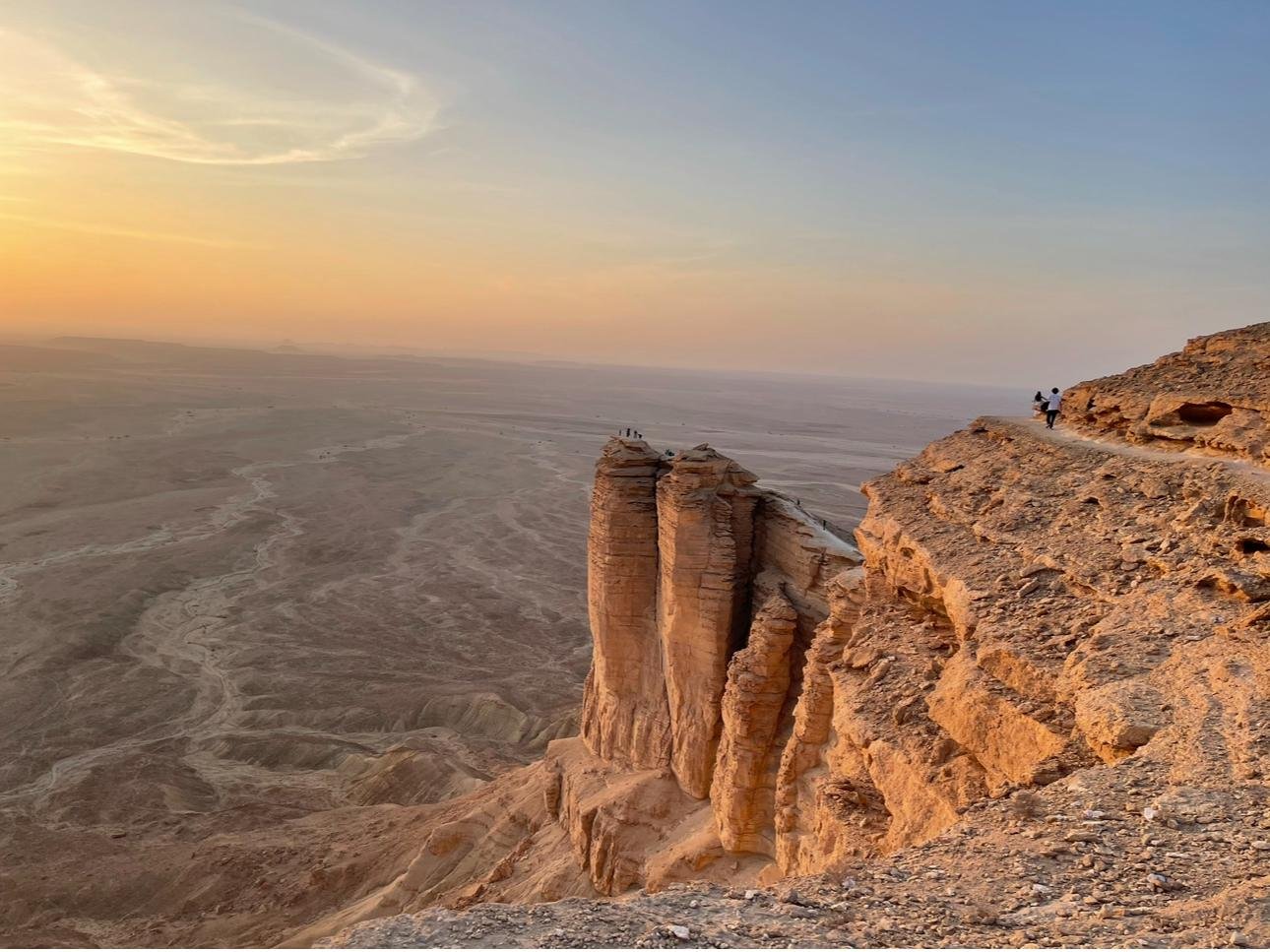
The signature clifftop drop plunges roughly 300 metres straight down onto a flat gravel plain that was once an ancient ocean bed, part of the 800-kilometre Tuwaiq Escarpment. On a clear day the view extends more than 100 kilometres to the horizon with no structures in sight.
A limestone cave near Jubaylah along the approach route, notable for a small pool of freshwater inside its chambers despite the surrounding arid desert. Local guides often add it as a short detour before the main clifftop stop.
A sheltered desert valley lined with acacia trees that forms one of two main access routes to the escarpment, offering a greener contrast to the surrounding rock and gravel plains.
Sections of the plateau trail follow what was once a historic caravan path used for centuries to move goods across the Arabian Peninsula, with faint traces of the route still visible on foot.
Because the region was once an ancient seabed, the exposed rock layers along the escarpment trails contain visible marine fossils such as seashells and coral fragments millions of years old.
A smaller cave near the main site, formed partly of quartz-flecked rock, home to a resident bat colony and included as an optional stop on several guided overnight itineraries.
You leave Riyadh in the afternoon and watch the tarmac give way near Sadus, where the road turns to graded track and your driver drops tyre pressure for the last stretch. Most edge of the world overnight tour tours aim you at the escarpment inside the 15:00–20:00 arrival window, which puts you on the rim with the low sun still working across the plain below. You walk the final two hundred metres on foot. The ground is loose limestone scree, so you place your feet deliberately. At the promontory the cliff simply stops — no railing, no barrier, just a drop of several hundred metres and a plain that runs flat to the horizon. You sit. The light goes copper, then rose, then flat grey, and the temperature drops noticeably within twenty minutes of sunset. Camp is usually set back from the rim. You eat around a fire — kabsa, flatbread, cardamom coffee poured from a dallah — while the last vehicles from the day trips grind back toward the highway. Then the sky opens. You lie back on a rug and let your eyes adjust for fifteen minutes; the Milky Way resolves into a band with visible structure. In the morning you wake before the heat, walk the rim again in first light, and see the wadi channels you missed the night before.
All the details about your upcoming adventure in one place
The edge of the world overnight tour takes you 90 kilometres northwest of Riyadh to Jebel Fihrayn, where the Tuwaiq Escarpment drops away in a sheer limestone wall above the ancient caravan plain. Guests travel by 4x4 across desert track, watch the sun fall behind the cliff line, and sleep in a serviced desert camp under open sky. Most edge of the world overnight tour tickets include transport, camping equipment, dinner and breakfast.
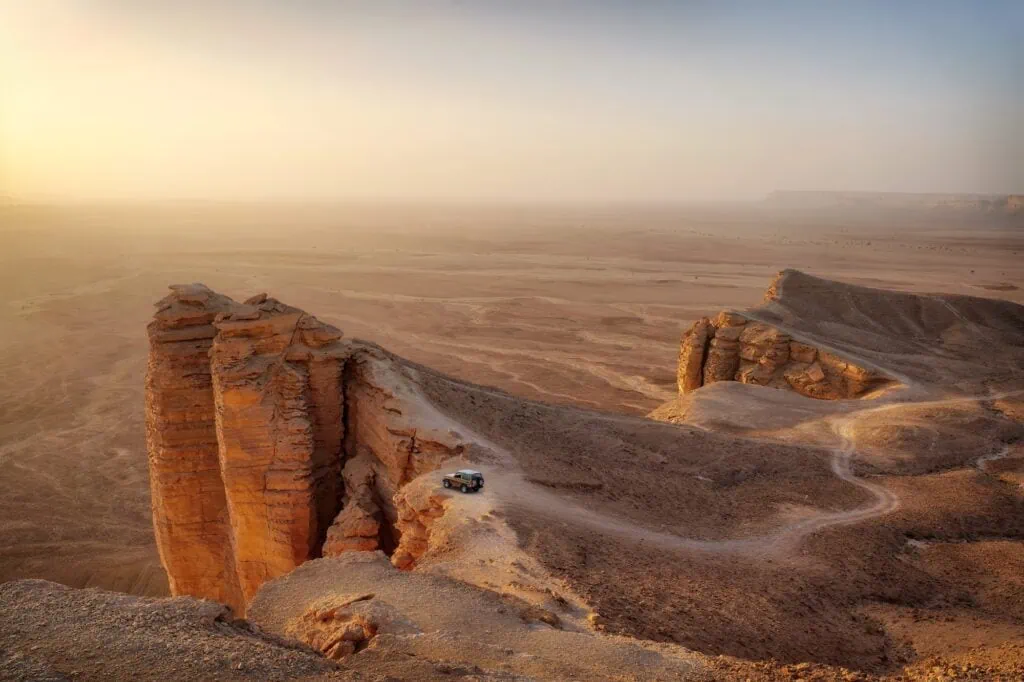
The cliff Riyadh calls the Edge of the World was once a seabed. The Jebel Fihrayn escarpment, part of the wider Tuwaiq range, is built from Jurassic limestone laid down roughly 150 million years ago beneath a shallow tropical ocean. Fossilised marine shells still sit in the rock face, several hundred metres above a plain that has been dry for longer than any human record. The escarpment runs for some 800 kilometres in a long crescent through central Arabia, and Jebel Fihrayn is the point where it breaks most abruptly. Ancient caravan routes threaded the valleys below, using the wadis as natural corridors between the Najd interior and the settlements to the northwest. Sadus, the village most visitors pass through on the drive out, preserves the ruins of a mud-brick fort and a pre-Islamic settlement layer — a reminder that this landscape was never empty, only sparsely written. What makes an edge of the world overnight tour distinct from a day trip is not the view but the dark. The site sits 90-100 km northwest of Riyadh, far enough that the capital's light dome stays low on the southeastern horizon. On clear nights the Milky Way is visible to the naked eye across most of the sky. Bedouin navigation traditions in the Najd used this same sky, and constellation names in local Arabic still carry those older functions. Guided جولة حافة العالم الليلية itineraries now build around that inheritance, pairing camp meals with unaided-eye astronomy. The formal status of the place has shifted quickly. Once reached only by unmarked desert tracks known to Riyadh's off-road community, Jebel Fihrayn is now a signed destination within Saudi Arabia's tourism programme, with graded access roads and an established operator ecosystem. Entry remains 0 SAR — this is an open desert site with no gate or ticket booth — which means the cost of any edge of the world overnight tour reflects transport, camp infrastructure and guiding, never admission. Architecturally, there is nothing here but geology. That is the point. The cliff terminates in a series of natural promontories, the most photographed of which extends over the plain like an unfinished bridge, its underside undercut by millennia of wind scour. Talus fans spread below. Wadi channels braid across the floor in pale lines visible only from height. Riyadh desert landmarks tend toward the built and the modern; this one predates all of it, and offers a horizon uninterrupted by any human structure at all — a rarity within ninety minutes of a city of eight million.
The cliff Riyadh calls the Edge of the World was once a seabed.
Wear closed, sturdy shoes with grip for loose gravel and rock — sandals or flip-flops are not suitable near the cliff edge. Layer up for an edge of the world overnight tour, since daytime desert heat gives way to a sharp temperature drop and strong wind once the sun sets over the escarpment. Modest, loose-fitting clothing is advisable in line with general norms for public desert sites in Riyadh Province.
There is no security checkpoint, bag scanner, or ranger station at the escarpment itself, so visitors are responsible for their own belongings at all times. Most edge of the world overnight tour vehicles have limited luggage space, so a single soft daypack per person is recommended over hard suitcases. Keep valuables zipped and close to you near the unfenced drop, since a dropped bag near the ledge cannot be retrieved.
Personal photography and drone use for private, non-commercial purposes are generally tolerated at the escarpment, though drone flights should stay well clear of other groups and any nearby camps. There is no flash restriction and no fee for photography, but tripods should be set back from loose gravel edges. Commercial shoots or filming with professional crews may require separate permission from Saudi tourism authorities.
Children must be closely supervised at all times given the unfenced 300-metre drop and lack of barriers. Most tour operators accept children on an edge of the world overnight tour but recommend it for kids old enough to follow safety instructions near cliff edges.
The site has no paved paths, ramps, railings, or fencing, and the terrain is loose gravel and rock right up to a sheer, unmarked drop. It is not accessible for wheelchairs, strollers, or visitors with limited mobility, and an edge of the world overnight tour is generally unsuitable for anyone unsteady on uneven ground. There are no restrooms, shade structures, or paved parking at the escarpment itself.
Carrying your own food and water is essential, since there are no shops, stalls, or refreshment stands anywhere on the escarpment. Alcohol is prohibited under Saudi law, so any evening meal on an edge of the world overnight tour is alcohol-free by default. Pack out all food waste and packaging, as there are no bins on site.
No staff on-site overnight
Quietest weekday for photos
Busier as weekend nears
Peak crowds, weekend start
Peak crowds, weekend day
Hours
Open 24 hours, every day — no gate or ticket booth
Car · 1.5–2 hours from central Riyadh · Fuel cost only, roughly 150–250 SAR round trip
Self-drive via Route 40 (Makkah Highway) or the Sadus road through Jubaylah, then a rough gravel track for the final 15–30 km requiring a 4×4
Taxi · 1.5–2 hours to Sadus, plus onward 4x4 transfer · Fare varies by app, plus separate 4x4 transfer
Standard taxis and ride-hail apps can reach Sadus village but cannot handle the final off-road stretch to the escarpment
Public transport · Metro to pickup point, then 1.5–2 hours by tour vehicle · Riyadh Metro fare plus tour cost
No public bus or metro line reaches the escarpment; the nearest urban transit is Riyadh's metro network, useful only for reaching a tour pickup point in the city
Bike · Not recommended · N/A
Not a viable option for the full route due to distance, heat, and unpaved desert terrain on the final approach
Most edge of the world overnight tour operators allow free cancellation up to 24 hours before the scheduled departure time, with a full refund. Since the site itself charges 0 SAR entrance fee, refund terms apply only to the tour or transport booking, not to a site ticket.
Recommended time
5-7 hours (overnight camp extends this)
Most visitors treat an edge of the world overnight tour as a single afternoon-to-night arc rather than a fixed number of hours at the rim itself: arrival, golden hour, camp setup, dinner, stargazing, and sleep. Add 30-60 minutes if the group lingers for photos after sunset or if off-road conditions slow the approach, and subtract time only by skipping dinner and departing right after dark. There is no queue or ticket line to worry about since entry is free and ungated, so the only real bottleneck is finding parking space near the rim during peak arrival.
Crowd levels through the day
Weather · crowds · average price — dots go green to amber to red as each metric rises.
Cooler daytime temperatures around 20–28°C make hiking and overnight camping far more comfortable, and this stretch is widely cited as the ideal season for visiting Jebel Fihrayn. Clear, dry skies also give the sharpest stargazing conditions.
Spring shoulder season with warming days but still mild evenings, before the summer heat sets in fully. Crowds are moderate compared to winter weekends.
Summer daytime heat is intense, often exceeding 40°C, so an edge of the world overnight tour in this window should center on late afternoon arrival and evening hours rather than midday exposure. Nights remain warm but the wind at the cliff top offers some relief.
Transitional month with gradually cooling evenings; a lower-crowd alternative to the winter peak season while conditions start to ease.
Regular sedans cannot handle the final 15–30 km of loose gravel and sand; a licensed guide also knows the Sadus and Acacia Valley routes and current gate access.
There are no shops or refreshment stands anywhere on the escarpment, so bring 2–3 liters per person plus extra for an overnight stay.
The Acacia Valley gate is reported open on weekends only, while the Sadus Dam route is described as open daily, so confirm your route in advance.
The exposed clifftop gets notably windier and cooler after sunset even in summer, so a light jacket makes the overnight stay more comfortable.
There are no barriers or warning signs along the 300-metre drop, so keep a firm distance, especially with children or in low light.
Mobile signal is unreliable on the desert tracks and disappears entirely in some stretches near the cliff.
Solo or small-group visits should always share a planned return schedule, since rescue access on the plateau is limited.
Riyadh, Saudi Arabia
Common pickup point stated by some tour operators near central Riyadh
Get directionsRoute 5762 near Sadus, Riyadh Province
Waypoint where paved road ends and the desert track to the escarpment begins
Get directionsAcacia Valley, off Route 5766 near Jubaylah
Alternate access gate, open on weekends only per local operator reports
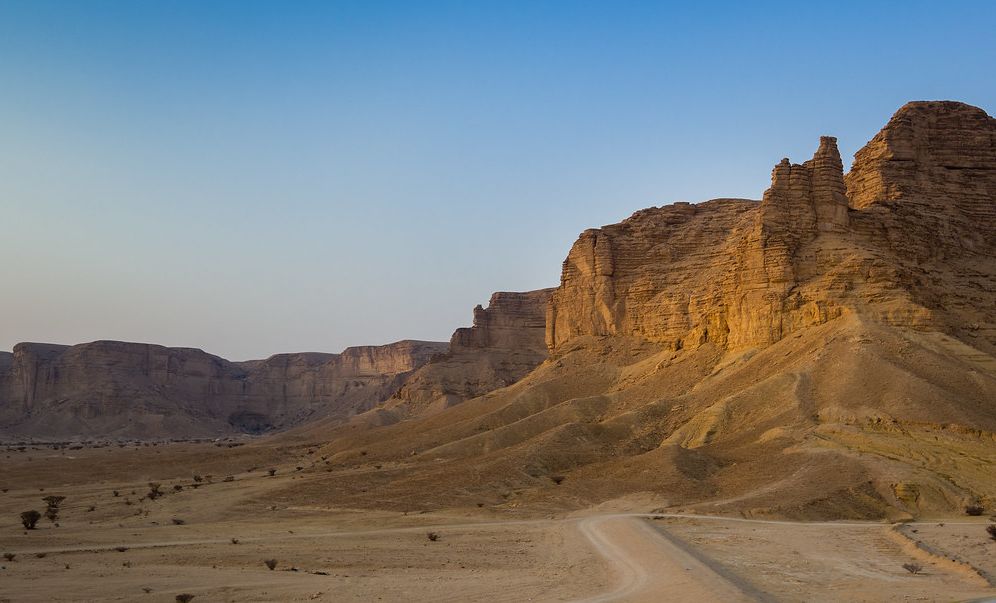
Get directionsThe Jebel Fihrayn escarpment begins underwater. During the Jurassic period, roughly 150 million years ago, a warm shallow sea covered central Arabia. Carbonate mud accumulated on its floor. Shells, corals and ammonites settled into that mud and hardened. The result is the Tuwaiq limestone, a pale rock layer that visitors on an edge of the world overnight tour still walk across at the cliff rim. Fossil bivalves remain visible in loose slabs at the base of the scarp. Uplift came later. Tectonic movement associated with the opening of the Red Sea, beginning around 30 million years ago, tilted the Arabian Shield and raised the plateau. Softer marls eroded first. Harder limestone caps resisted, leaving the 300-metre wall that curves for some 800 kilometres as the Tuwaiq Escarpment. Wadi Nisah and Wadi Al-Awsat cut the gaps that later became passes. Geologists mapped the formation in detail during the joint Saudi-American surveys of the 1960s, and the escarpment features on the Arabian Peninsula sheets published in that decade. Humans used those passes long before geology named them. The scarp face marks the western edge of the Najd plateau, and caravan routes threading below it linked the Arabian Gulf and Indian Ocean trade to the Mediterranean, carrying frankincense, textiles and East African goods. The Darb Zubaydah pilgrimage road, established under Abbasid patronage in the eighth century, ran further north, but the Sadus corridor served regional traffic toward Dir'iyah. The ruined settlement of Sadus, with its mudbrick fort and adjacent wells, sits along the modern approach and dates to the pre-Saudi era of Najdi oasis towns. Nothing was built at the cliff itself. There is no gate, no ticket booth, no admission charge — entry costs 0 SAR. That absence is the site's history in miniature: a landmark defined by erosion rather than construction. Modern Riyadh landmarks tours reached it only after the graded desert track improved in the 2010s, and an edge of the world overnight tour tour remains the common way to arrive. Operators selling edge of the world overnight tour tickets note that edge of the world overnight tour tours cluster in the 15:00–20:00 arrival window, when low sun rakes the limestone and the sky clears for stargazing.
A warm shallow sea deposits the carbonate muds that harden into Tuwaiq limestone.
Marine shells, ammonites and corals are entombed in the sediment, later exposed as surface fossils.
Rifting of the Red Sea tilts the Arabian Shield and lifts the plateau above sea level.
Caravan traffic uses the wadi gaps below the scarp to move goods between the Gulf, East Africa and the Mediterranean.
Abbasid patronage formalises Najd pilgrimage roads, increasing traffic across the plateau east of the escarpment.
The mudbrick settlement and fort at Sadus serve as an oasis stop on the northwest route from Dir'iyah.
Joint Saudi-American geological surveys map the Tuwaiq Escarpment and publish it on Arabian Peninsula sheets.
An improved graded desert track brings regular visitor traffic to the Jebel Fihrayn cliff edge.
The classic cliff-edge shot: stand right at the rim where the 300-metre limestone wall drops straight into the desert plain, with the horizon running unbroken from side to side. Most people booking an edge of the world overnight tour head here first, since it's the flattest and most open stretch of rim. Keep a few metres back from the lip for a stable footing when framing the shot.
Walk left (north) along the rim past the main viewpoint to a cluster of weathered limestone outcrops that break up the flat cliff line. These formations make good foreground shapes against the desert below and are far less crowded than the main lookout. The path is unmarked rock, so watch your footing on loose gravel.
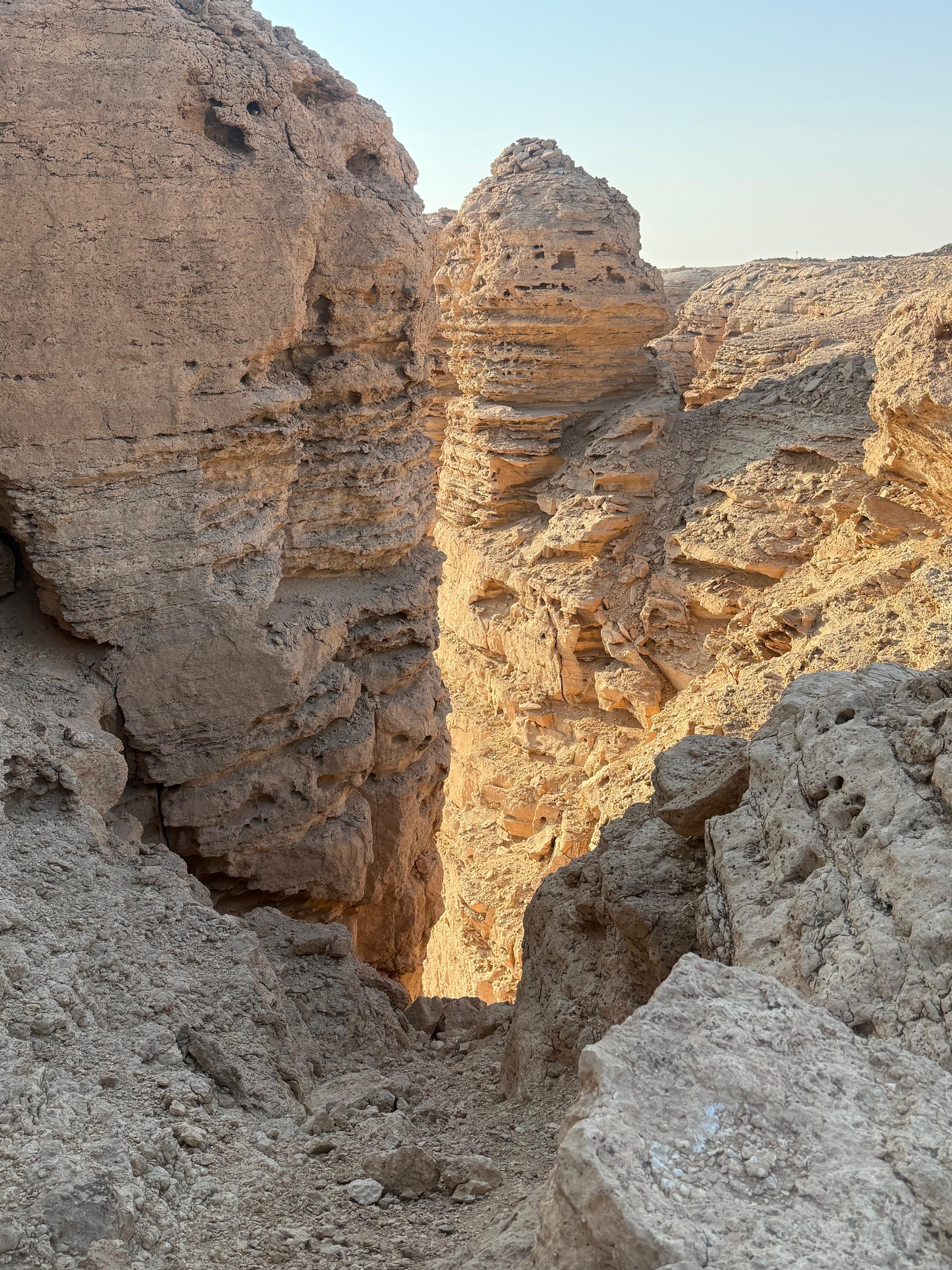
A narrow rock-framed gap in the escarpment nicknamed 'the window,' where a natural passage lets you descend partway toward the lower plateau. Shooting through the opening frames the valley floor like a portal, and standing just below it looking back up captures the rock arch itself. The scramble down is steep and loose, so move slowly.
Same rim used for sunset shots, repurposed after dark for stargazing and astrophotography, with no artificial light pollution to wash out the Milky Way. A tripod and long exposure capture the escarpment silhouette against the stars; this spot anchors the night half of any Jebel Fihrayn escarpment tour or tours built around overnight camping. Stay well clear of the unmarked drop when shooting in the dark.
Reached via the window passage, this vantage looks back up at the cliff wall from below, giving a sense of scale that top-down shots miss. It suits wide-angle shots showing the full height of the escarpment with tiny figures at the rim above.
An edge of the world overnight tour puts young children within a few steps of an unfenced 300-meter drop and a wild-camping setup with zero facilities, so this trip suits families who can guarantee constant, hands-on supervision rather than a relaxed desert landmarks getaway. Families uneasy with that exposure are better served treating it as a day trip only.
There are no rails or barriers at Jebel Fihrayn's escarpment, so young children need a hand-held grip or a harness-and-leash setup within several meters of any edge, day or night; this is the single biggest factor in whether an overnight suits your family.
Kids old enough to reliably follow a stop command and walk on uneven limestone, generally school-age and up, cope far better than toddlers, who are safest kept at the vehicle or tent rather than near the rim.
Pack a headlamp per child, a windproof shelter rated for cold desert nights, and a ground pad, since there are no facilities, no lighting, and temperatures drop sharply after dark even in summer.
Break the overnight into a short evening walk before dark, an early dinner, and a fixed camp perimeter kids know not to cross, rather than free-roaming exploration once the light fades.
Families uneasy with overnight exposure can do the sunset viewpoint and drive back to Riyadh the same night, skipping the camping setup while still catching golden hour.
There are no restrooms, shops, or medical points on site, so bring all water, food, and a basic first-aid kit sized for a full overnight rather than a few hours.
There is no restaurant, café, or kiosk at the cliffs themselves, so most people book an edge of the world overnight tour that bundles a Bedouin-style camp dinner and morning breakfast into the package, with a couple of real sit-down options only if you detour through Sadus or Diriyah on the drive out or back.
Charcoal-grilled chicken, lamb, rice, and salads served buffet-style at the overnight campsite after sunset; nearly every edge of the world overnight tour package includes this, and it is the only hot meal available near the escarpment itself.
Simple spread of eggs, flatbread, cheese, honey, and tea packed up before the drive back; quick and functional rather than a sit-down affair, timed for an early start.
A tour-favorite stop near Sadus for authentic Saudi cuisine like kabsa and grilled meats; several edge of the world overnight tour tours end or begin here, and it can get busy when multiple group buses arrive together.
A cluster of upscale Saudi, Lebanese, Italian, and French restaurants overlooking At-Turaif, worth a stop for travelers wanting a proper meal before or after joining an edge of the world overnight tour; best for a relaxed dinner rather than a quick bite.
A handful of small local cafés and grocery stops in Sadus town for a quick bite, fuel, or last supplies before the paved road ends; useful for those booking edge of the world overnight tour tickets that don't include meals.
Real experiences from real travelers
We booked the edge of the world overnight tour after two days in Riyadh and the contrast was the whole point — city noise to absolute silence in under three hours. The last stretch of track is rough gravel and our driver aired down the tyres before starting it. Standing on the rim with nothing but flat plain to the horizon does something to your sense of scale.
The Tuwaiq escarpment at night is darker than anywhere I have been in Europe. Our guide pointed out fossil shells in the limestone right at our feet, which was a strange thing to hold while looking out over dry desert. Coffee and dates by the fire, then sleeping bags under an open sky.
Sunrise over Wadi Al Ayn was the reason to stay the night rather than do a day trip. Haze sat in the old riverbed and burned off in about twenty minutes. Bring a fleece — July daytime is punishing but the small hours got genuinely cold.
The Jebel Fihrayn approach track shook the vehicle harder than I expected and anyone with a bad back should know that in advance. Camp itself was well set up and the crew handled everything. I would have liked more time on the rim before dark.
We compared edge of the world overnight tour tours from a few operators and picked the one with the smallest group, which was the right call. Twelve people on that cliff edge feels spacious; forty would not. The layered sedimentary walls change colour completely between arrival and last light.
Our Riyadh escarpment tour left mid-afternoon so we hit the rim with maybe ninety minutes of usable light. That was enough to walk out along the ridge and find a spot away from the vehicles. No phone signal at all once you leave the highway, which nobody warned us about but I did not mind.
November nights out at the escarpment drop further than the forecast suggests. The camp had thick blankets and a windbreak, so it was fine, but the guide said many guests underestimate it. Milky Way was visible with the naked eye by around ten.
Picking up marine fossils on a cliff in the middle of a desert is a peculiar feeling and our guide explained it well without turning it into a lecture. He asked us to put them back, which I appreciated. Booking edge of the world overnight tour tickets a week ahead was enough in low season.
Late August was hot enough that we did almost nothing between arrival and sunset except sit in shade drinking water. Once the sun went behind the ridge the temperature became pleasant and the evening was the best part. The edge of the world overnight tour suited us better than trying to squeeze it into a day.
Winter timing meant comfortable walking conditions along the rim and very few other vehicles at the top. Our escarpment overnight tour included a second viewpoint on the way out that most groups skip. Standing there with the plain running flat to the horizon is not something photographs carry across.
Everything you need to know for your journey
The Jebel Fihrayn escarpment is an open desert site with no gate, so it is accessible 24 hours a day, every day of the week.
No, entrance is free — there is no gate or ticket booth, so an edge of the world overnight tour carries 0 SAR in site admission fees.
Yes, a 4x4 is strongly recommended for the final 15–30 km stretch of loose gravel and sand leading to the escarpment; most visitors join a guided tour with an experienced driver rather than self-driving in a sedan.
No, the site has no paved paths, ramps, or railings, and the uneven rocky terrain makes it unsuitable for wheelchairs or strollers.
Bring sturdy closed shoes, 2–3 liters of water per person, layered clothing, a headlamp, sunscreen, and a downloaded offline map, since there are no facilities on site.
Yes, children are generally welcome on an edge of the world overnight tour, but they must be closely supervised at all times given the unfenced cliff edge.
No, there are no shops or stalls at the escarpment, so all food and water must be brought along; alcohol is prohibited under Saudi law.
Arriving between 15:00 and 20:00 gives golden hour views and clear night skies, and the cooler months from October to March are generally the most comfortable for a full edge of the world overnight tour.
Most travelers depart central Riyadh by car or tour vehicle, driving 1.5 to 2 hours northwest via the Sadus or Acacia Valley routes before transferring to a 4x4 for the final off-road stretch.
Most operators allow free cancellation up to 24 hours before departure with a full refund on the tour or transport booking.
Personal photography and drone use for private purposes are generally tolerated, though drones should be flown away from other groups and commercial filming may need separate permission.
Nearby stops include Ain Heet Cave, Acacia Valley, Sadus village, and the Diriyah At-Turaif District, all of which pair well with a broader day of Riyadh landmarks.
A natural limestone cave near Jubaylah with a small freshwater pool inside, reachable off the same route toward the escarpment. It is a popular stop for groups combining caving with the clifftop visit.
A scenic desert valley along one of the two access routes to the escarpment, lined with acacia trees and sheltered rock formations.
A small historic village along Route 5762 that marks the transition from paved road to desert track, with traditional mudbrick structures.
An alternate viewpoint along the broader Tuwaiq Escarpment offering panoramas distinct from the main clifftop.
A UNESCO World Heritage mudbrick district and birthplace of the first Saudi state, on the way back toward Riyadh.
A cluster of hotels near the historic Diriyah district in Riyadh, convenient for travelers combining a city stay with an edge of the world overnight tour departure.
International luxury hotel brands cluster in central Riyadh near King Fahd Road, the typical starting point for tours to the escarpment.
Tent-based overnight camping run by tour operators directly at or near the clifftop, with no fixed structures or amenities.
Small local guesthouses near Sadus offering a simpler, closer base before the final off-road stretch.
Join thousands of happy travelers who have discovered this incredible experience
Book Your Experience Now